 Phantomwallet
Phantomwallet staking lets you delegate SOL directly or hold liquid PSOL
Updated:
Phantomwallet staking can earn SOL rewards through native validator delegation or liquid staking with Phantom Staked SOL (PSOL). Native staking keeps SOL in a stake account and lets you select the validator. Liquid staking gives you a tradable token representing pooled stake and rewards. The choice turns on validator control, access to your funds, and additional pool risks. Immediate PSOL unstaking for SOL depends on available pool reserves.
Key takeaway: Unstaking PSOL in Phantom can return a native stake when reserves are insufficient, so spendable SOL may require deactivation and withdrawal.
Reward distribution in native stakes and PSOL
Native staking rewards add SOL to your stake account, while PSOL reflects pool rewards in the amount of SOL each token represents.
SOL credited to a native stake
Native rewards depend on the effective stake earning rewards, validator voting performance, and network reward allocation. Solana's inflation and total active stake influence the available reward rate. Validator commission reduces the rewards you receive. Rewards credited to the stake account join its delegated balance, so compounding doesn't require a separate claim. An annualized estimate describes a changing reward rate, not a fixed payment schedule or a promised cash return.
Rewards represented by PSOL
PSOL represents a share of a staking pool. As the pool receives rewards, its SOL backing per token can increase without increasing your PSOL count. Phantom's liquid staking includes staking rewards, priority fee rewards, and MEV tips. MEV means maximal extractable value and concerns value obtained from transaction inclusion and ordering. Those additional reward sources vary with network activity. Track rewards through the SOL value represented by your tokens.
Staking access and account records
Phantom creates new native stakes through its browser extension; liquid staking is available in both the extension and mobile app.
Native staking in the extension
A new native delegation must meet the minimum displayed in Phantom's staking form and leave spendable SOL for transaction costs. The Solana asset's staking menu provides native staking and validator selection. Mobile can display, deactivate, and withdraw existing native stakes even though it doesn't create them. Each stake account has an address separate from your wallet's main address. Its on-chain record identifies the delegation, stake status, and authorities controlling the account. A confirmed delegation request doesn't establish that all the stake is already active.
PSOL on mobile and desktop
Liquid staking uses the Phantom Staked SOL asset's staking action and a SOL amount you review before approval. The PSOL balance represents the liquid position; native stakes appear separately under the Solana asset. Check the selected wallet address when comparing balances across devices. A different account can show a different position even when both devices run Phantom. Token swaps provide another way to obtain PSOL, with execution details belonging to that swap.
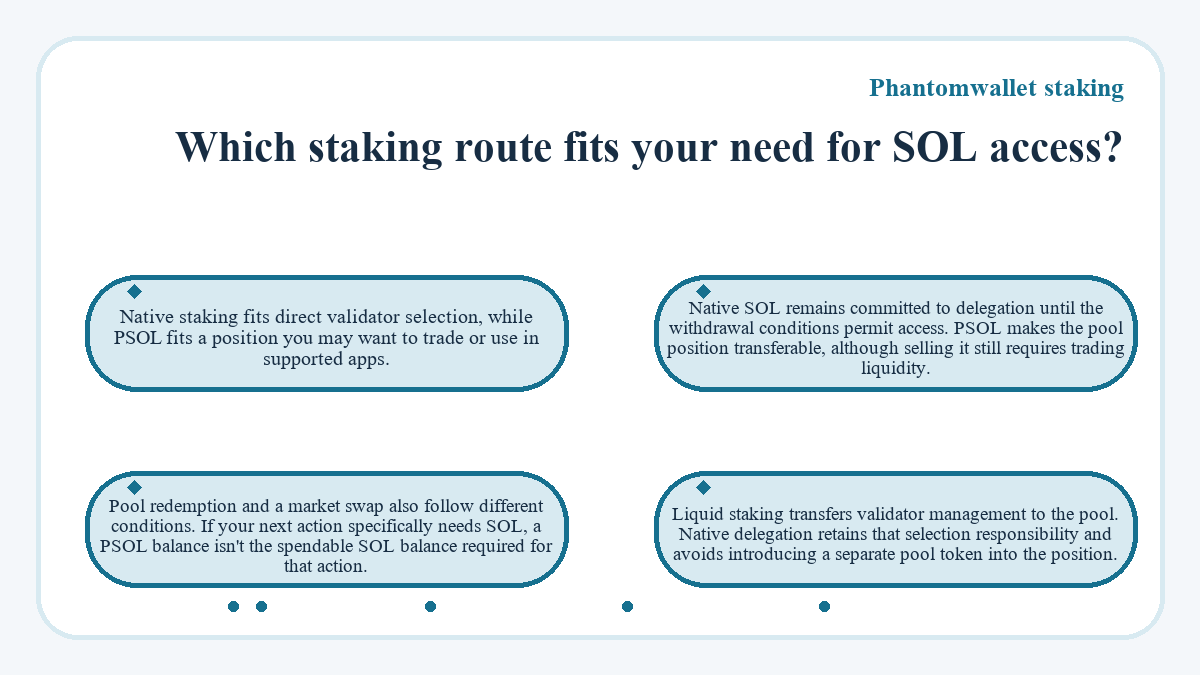
Which staking route fits your need for SOL access?
Native staking fits direct validator selection, while PSOL fits a position you may want to trade or use in supported apps. Native SOL remains committed to delegation until the withdrawal conditions permit access. PSOL makes the pool position transferable, although selling it still requires trading liquidity. Pool redemption and a market swap also follow different conditions. If your next action specifically needs SOL, a PSOL balance isn't the spendable SOL balance required for that action.
Liquid staking transfers validator management to the pool. Native delegation retains that selection responsibility and avoids introducing a separate pool token into the position.
Validator choice and withdrawal authority
Native delegation adds voting weight to your chosen validator while your stake account's authorities retain control over delegation and withdrawals. A Solana stake account can delegate to only one validator at a time. Spreading native delegation across validators therefore requires separate stake accounts. The stake authority manages delegation; the withdraw authority controls withdrawals of eligible SOL. Delegating doesn't transfer withdrawal control to the validator. A recorded lockup can impose an additional withdrawal restriction even after deactivation. Authorizing a change of withdraw authority gives another address withdrawal control, making that approval different from ordinary delegation.
An offer to unlock staked SOL by requesting your Secret Recovery Phrase exposes wallet control. Normal staking rewards don't require entering that phrase into a website.
Commission, pool fees, and transaction funding
Staking costs apply to different amounts: validator commission and pool reward fees affect earned rewards, while Phantom's exit fee applies to PSOL when unstaking or swapping out of PSOL. Pool reward fees sit on top of the validator commissions already reflected in pool earnings. Read the pool's fee configuration and the exit details for the applicable percentages and their calculation bases. A PSOL-to-SOL swap has its own execution quote, so its net output can differ from pool redemption. Solana transaction costs also include a base fee and any prioritization fee, independently of staking rewards.
Keep spendable SOL available for native stake operations, including withdrawal. SOL committed to delegation can't fund the wallet's transaction fees.
Reserve-funded exits and delayed withdrawals
PSOL unstaking in Phantom normally returns SOL from pool reserves, but insufficient reserves can make the exit return a native stake requiring further action.
SOL returned from reserves
With sufficient reserves, a PSOL unstaking request exchanges the selected pool tokens for SOL returned to the wallet. Reconcile the successful transaction's net output with the received SOL balance. A transaction identifier alone doesn't establish successful execution.
A native stake returned instead
When the exit produces a native stake, that account needs deactivation before its delegated SOL becomes withdrawable. The Unstake action starts the cooldown. Epoch transitions and network-wide stake transition limits govern when the stake becomes inactive, so a calendar estimate isn't a completion signal. Once the stake meets its withdrawal conditions, Withdraw Stake returns SOL to the wallet. The same distinction applies to an existing native delegation: successful deactivation doesn't automatically withdraw its balance.
- If an exit returned a stake account, inspect its status before requesting withdrawal.
- If the stake is still deactivating, wait for the withdrawal conditions to change.
- If an inactive account has a lockup, account for its recorded release condition.
- If native withdrawal failed for insufficient fee funds, add spendable SOL before retrying.
- If Phantom's display conflicts with the successful transaction, refresh it and inspect the on-chain account before repeating the request.
PSOL trading and additional app exposure
PSOL can be traded or used in decentralized finance apps supporting the token, adding liquidity choices and additional contract exposure. A market quote reflects available trading liquidity and can differ from the pool's SOL backing per token. Thin liquidity can make a rapid sale costly even while the underlying stake continues earning rewards. Depositing PSOL into another app adds that app's contracts and conditions to the staking pool's risks. Holding PSOL without that additional deposit avoids the extra app exposure. Native delegation avoids the pool token's market and program exposure while retaining validator performance and cooldown constraints.
Reader questions
-
Will adding SOL increase an existing native stake in Phantom?
- Phantom's native staking interface requires another stake or an unstake-and-restake operation to increase the delegated amount. Sending SOL directly to an existing stake account isn't the same as adding active delegation. The Solana protocol can accept that transfer, but the added funds don't automatically become delegated stake.
-
Where can I see the reward total for PSOL held on mobile?
- Phantom shows the PSOL reward total on the token page in its browser extension, rather than its mobile app. Open the same wallet address in the extension to inspect that position. A missing mobile reward display doesn't establish that the pool stopped earning rewards.
-
Can an existing native SOL stake convert to PSOL?
- Phantom supports converting an existing native SOL stake to PSOL through its conversion option on mobile and in the browser extension. Phantom deactivates the native stake before converting it. This changes the holding from direct delegation to a pool token, whose rewards and exits follow the liquid staking mechanism.
-
Why does the PSOL earnings display remain empty after staking?
- The earnings display can remain empty until accrued rewards exceed the exit fee included in Phantom's calculation. Reward updates generally follow Solana epoch changes, so an immediate display change isn't required. That display condition concerns calculated earnings; it doesn't mean the PSOL token count should increase.
-
Does earning more SOL protect a staking position's value in dollars?
- Additional SOL rewards don't protect the position from a fall in SOL's dollar price. Staking tracks token rewards, while the market determines their cash value. A native stake or PSOL holding can represent more SOL and still have a lower dollar value.
-
Is Phantom required to stay open for native staking rewards?
- Native staking continues on Solana when Phantom is closed. Reward eligibility follows effective delegation and validator participation, rather than time spent running the wallet. Opening Phantom displays the position; it doesn't start a separate reward calculation. Rewards credited to the native stake account compound without keeping the app open.